Why Wristwatches Are Surging in 2026 Rolex Beats Smartwatches and the Royal Pop Effect
Wristwatches were supposed to be under pressure from phones, fitness bands, and smartwatches. Instead, 2026 has turned them into one of the most interesting consumer stories of the year.
Searches for wristwatches are up 90% compared to 2025, a jump large enough to suggest more than a passing style moment. People are not only browsing for “best watches” or “men’s watches” in a casual way. They are searching for collaborations, vintage references, entry-level luxury pieces, Rolex models, colorful releases, and watches that say something about personal taste.
The surge is being pushed by several forces at once. The Swatch/Audemars Piguet Royal Pop collaboration has brought high-horology energy to a much wider audience. Rolex continues to outperform every smartwatch brand in US search volume, showing that traditional luxury still has a powerful hold on buyers. At the same time, consumers are treating watches as style objects, collectibles, milestone purchases, and alternatives to disposable tech.
The result is a market where a $100 playful watch and a five-figure grail piece can fuel the same conversation.
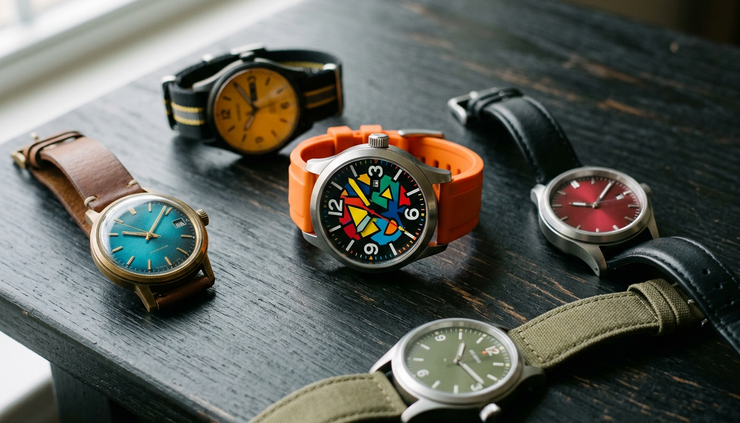
The 90% jump in wristwatch searches shows a wider cultural shift
A 90% increase in wristwatch searches compared to 2025 is not just a bump in consumer curiosity. Search behavior often reveals what people are thinking about before they buy, trade, gift, or collect. When search demand nearly doubles year over year, it points to a category gaining attention from multiple kinds of shoppers at the same time.
Some are enthusiasts tracking new releases. Some are first-time buyers who want one good mechanical watch. Some are fashion-focused shoppers looking for a bold accessory. Others are comparing smartwatches with traditional watches and realizing they serve very different needs.
The search surge also reflects how watch interest spreads now. A single release can move from watch forums to short-form video, resale listings, street style accounts, celebrity sightings, and mainstream shopping guides within days. That gives wristwatches a much larger audience than the old collector world.
Three behaviors stand out in 2026:
People are researching before they buy
Watches are considered purchases. Even casual buyers compare sizes, materials, brand history, strap styles, and resale value.
People are searching for identity, not only function
A phone tells time. A watch tells a story. That story might be practical, nostalgic, luxurious, sporty, artistic, or understated.
People are mixing price points
The same buyer might wear a Swatch collaboration during the week and save for a Rolex, Cartier, Omega, Tudor, or Grand Seiko later.
This mix has made the wristwatch category feel more active than it has in years. Mechanical watches appeal to people tired of screens. Quartz watches appeal to those who want easy ownership. Colorful collaborations bring in shoppers who may never have read a watch review before.
The search data suggests that watches are not coming back as a niche hobby. They are coming back as a broad consumer interest.
The Royal Pop effect made high-end watch culture feel accessible
The Swatch/Audemars Piguet Royal Pop collaboration has become one of the clearest drivers of the 2026 wristwatch boom. Its importance is not only the product itself. It is the bridge it creates between two very different parts of the watch world.
Swatch is known for color, accessibility, and playful design. Audemars Piguet is associated with elite Swiss watchmaking, especially through the Royal Oak, one of the most recognized luxury sports watches ever made. A collaboration under the Royal Pop idea puts those worlds in the same frame.
That matters because luxury watch culture can feel closed off. Prices are high. Availability can be limited. The language can be technical. A playful collaboration lowers the barrier. It gives casual buyers a way to participate in the conversation without needing a collector’s budget.
The Royal Pop effect works because it combines several powerful ingredients:
Driver | Why it matters |
A luxury reference point | Audemars Piguet gives the collaboration cultural weight. |
A mass-market entry point | Swatch makes the story easier for a broader audience to access. |
A strong visual identity | Color and recognizability help watches spread online. |
Collectible energy | Limited or talked-about releases create urgency and repeat searches. |
Conversation value | People search not only to buy, but to understand the hype. |
The collaboration also benefits from the success of earlier high-low watch moments. Swatch has already shown how a playful partnership can pull people into analog watches. These releases create lines outside stores, resale chatter, ranking videos, model comparisons, and debates about whether the watch is “worth it.”
That debate is part of the appeal. Some collectors may see a collaboration as a fun novelty. New buyers may see it as their first meaningful watch. Fashion shoppers may see it as an accessory with a good story. Each group searches for different reasons, but all of them add to demand.
Royal Pop also taps into a larger 2026 consumer mood. Buyers want luxury cues, but they do not always want luxury seriousness. They want color, humor, and personality. A watch that feels collectible and fun fits that mood perfectly.
Rolex beats smartwatches because it means more than timekeeping
One of the most interesting parts of the 2026 watch surge is that Rolex outperforms all smartwatches in US search volume. At first, that seems surprising. Smartwatches are widely used, heavily advertised, and packed with features. They track workouts, show notifications, control music, process payments, and monitor health metrics.
Rolex does none of that. It still wins search.
The reason is simple. Rolex is not competing on features. It competes on meaning.
In the US, Rolex functions as a universal symbol. Even people who know very little about watches understand the brand. It signals success, permanence, taste, and achievement. A Rolex search might come from a serious buyer, a curious browser, a gift shopper, a collector tracking references, or someone comparing resale prices. The brand generates demand far beyond the number of people ready to buy one today.
Smartwatch search behavior is different. Many users search by specific product names, such as Apple Watch, Garmin, Samsung Galaxy Watch, or Fitbit. The market is fragmented across tech ecosystems and use cases. Rolex, by contrast, concentrates attention under one name.
There are other reasons Rolex dominates search:
Model curiosity is constant
Submariner, Daytona, GMT-Master II, Datejust, Day-Date, and Oyster Perpetual all have strong identities. Each model creates its own search path.
Scarcity keeps people checking
Limited availability at retail has trained buyers to search for waitlists, market prices, authorized dealers, and used inventory.
Resale interest expands the audience
People search Rolex not only as jewelry, but as a durable luxury good with an active secondary market.
The brand is easy to understand
A smartwatch requires comparison charts. A Rolex needs very little explanation.
It does not become obsolete in the same way
A smartwatch ages like technology. A mechanical watch can age like an object of design.
That last point is crucial. Smartwatches are useful, but they come with upgrade cycles. Batteries weaken. Software support changes. New sensors arrive. A traditional watch offers a different promise. It can be serviced, passed down, and worn for decades.
That does not mean smartwatches are losing relevance. They remain practical devices. For many people, they are the best choice for workouts, notifications, and everyday utility. The difference is emotional gravity. A smartwatch is often something people use. A Rolex is something people aspire to, research, remember, and talk about.

Luxury watch buyers want heritage, scarcity, and personality
The 2026 surge shows that consumers are not moving in one single direction. The luxury watch market is being shaped by several preferences at once, and some of them pull against each other in interesting ways.
Many buyers still want heritage. They are drawn to brands with long histories, recognizable models, and designs that have not changed much over time. That is why watches like the Rolex Submariner, Cartier Tank, Omega Speedmaster, and Audemars Piguet Royal Oak remain so powerful. They feel stable in a market full of short-lived trends.
At the same time, shoppers want more personality. Colorful dials, smaller case sizes, vintage-inspired designs, integrated bracelets, rubber straps, and playful collaborations are all part of the current mood. The old idea that a serious watch has to be conservative no longer fits the whole market.
This split helps explain why both Rolex and Royal Pop can thrive in the same year. One satisfies the desire for lasting value and status. The other satisfies the desire for access, fun, and immediacy.
Smaller and more wearable sizes are back in focus
For much of the 2000s and 2010s, large watches dominated. In 2026, interest has shifted toward more wearable sizes. Many buyers now look for watches that sit comfortably under a cuff, fit a wider range of wrists, and feel less flashy.
That does not mean big watches are gone. Sport watches and tool watches still have a strong audience. But the growing interest in 36 mm, 38 mm, and 39 mm cases shows that proportion matters again. A watch feels more personal when it fits well.
First-time luxury buyers are doing more homework
New luxury watch buyers are more informed than ever. They read reviews, compare retail and secondary prices, study reference numbers, and watch owner videos before making a purchase. Search volume rises because the path to buying is longer and more research-heavy.
These buyers often ask practical questions:
Will this watch hold interest over time?
Is it comfortable enough to wear daily?
Can it be serviced easily?
Is the design too trendy?
Does the brand carry real history?
Will it still feel right five years from now?
This kind of research supports established brands, but it also helps smaller and independent watchmakers. Buyers who start with Rolex searches may end up discovering Tudor, Nomos, Longines, Oris, Zenith, Grand Seiko, or independent microbrands.
The secondary market keeps watches in the news
The pre-owned and secondary watch market has made pricing more visible. Buyers can see asking prices, track demand, and compare references in real time. That has made watches feel more like an active category, not just a retail product.
This visibility can attract buyers, but it can also create caution. After the sharp price swings seen in recent years across parts of the luxury watch market, many consumers now think harder about value. They may still want a prestigious watch, but they are less likely to assume every hyped model will keep rising.
That is a healthy shift. It encourages people to buy watches they genuinely enjoy wearing, not only watches they think might appreciate.
Why analog watches feel fresh in a screen-heavy world
The wristwatch surge is also cultural. Many people spend the day surrounded by screens, alerts, dashboards, and apps. A traditional watch offers a small break from that environment.
It is physical. It has weight. It catches light. It can be wound, adjusted, strapped on, and kept. Even a simple quartz watch gives the wearer a tactile object in a world where many products are invisible services or software subscriptions.
Analog watches also create a sense of ritual. Putting on a watch before leaving home feels different from charging a device. Choosing a strap or dial color feels more personal than choosing a phone case. For enthusiasts, the appeal goes deeper, into movement finishing, case construction, bracelet design, and the history behind a model.
For casual buyers, the appeal may be simpler. A watch completes an outfit. It marks a promotion, graduation, anniversary, or birthday. It can become an everyday signature.
That is why the current demand is not purely nostalgic. Watches are old technology, but the desire behind them is current. People want objects that feel lasting, expressive, and less disposable.
What the 2026 surge means for the watch market
The 2026 surge in wristwatch popularity does not mean every brand will benefit equally. Search interest can rise faster than sales, and hype can fade if products disappoint. Still, the signals are strong.
The winners will likely be brands that understand three things.
First, entry points matter. Collaborations like Royal Pop show that accessible products can build interest in the wider watch world. A buyer’s first fun watch can become the start of a long collecting journey.
Second, trust matters. Rolex dominates search because it has built decades of recognition and desire. Other brands may not match that level, but they can win by being clear about design, quality, availability, and service.
Third, personality matters. The luxury watch buyer of 2026 is not only looking for a safe black-dial sports watch. Many want color, texture, history, and a point of view. They want watches that feel specific.
The most durable trend may be the blending of audiences. Enthusiasts, fashion buyers, tech users, collectors, and first-time shoppers are now part of the same conversation. That makes the category bigger, louder, and more unpredictable.
Wristwatches are surging because they do something rare in modern consumer culture. They combine utility, memory, style, craft, and status in one small object. Smartwatches may win on features, but traditional watches are winning attention in a different way.
In 2026, the wrist is no longer just a place for notifications. It is a place for taste, identity, and a story worth searching for.


Comments